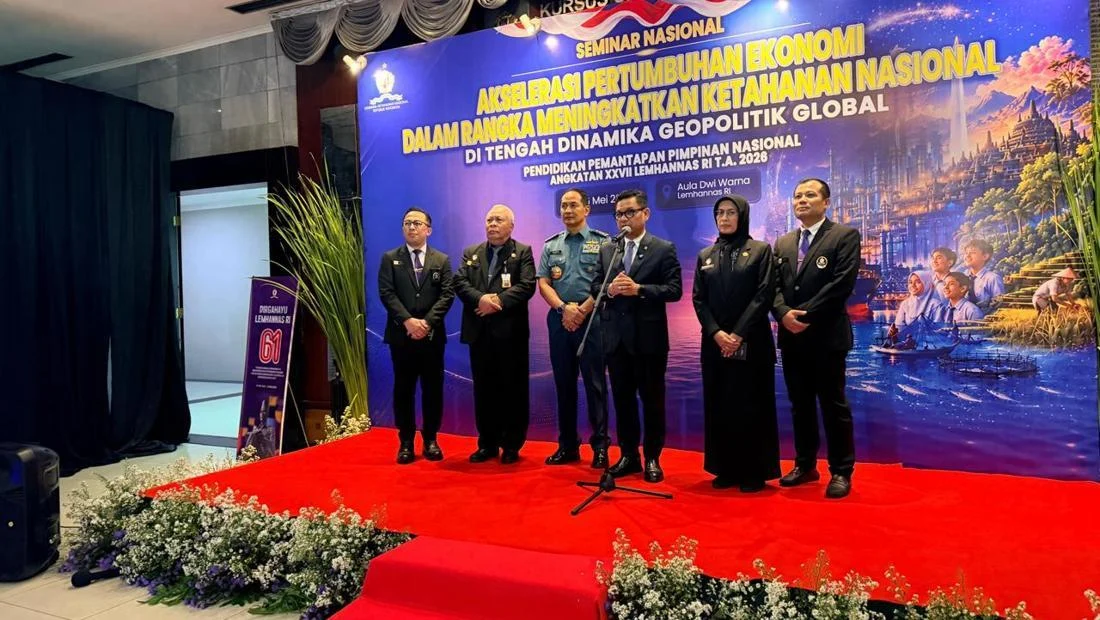
Jakarta – Governor of the National Resilience Institute (Lemhannas), Ace Hasan Syadzily, expressed optimism regarding Indonesia’s economic growth, which has reached 5.6 percent. He emphasized the critical need for all stakeholders to actively foster and sustain this positive trajectory amidst the complexities of the global geopolitical landscape.
Speaking at the opening of the National Seminar on Education for National Leadership Strengthening (P3N) 27, held at the Dwi Warna Purwa Room, Lemhannas RI, on Tuesday, May 26, 2026, Ace stated that continuous efforts are essential to maintain and further enhance this growth in the coming years. The seminar, themed ‘Accelerating Economic Growth to Enhance National Resilience Amidst Global Geopolitical Dynamics,’ was deemed highly pertinent to the current national economic situation.
In the first quarter of 2026, Indonesia’s economy demonstrated a robust growth of 5.6 percent. This achievement places Indonesia as the second-fastest-growing economy among G20 member nations, underscoring the nation’s strong economic resilience in the face of global uncertainties. Ace highlighted that this positive momentum aligns with the directives of President Prabowo Subianto, who, during a plenary session at the Parliament Building, set a macroeconomic framework for economic growth ranging between 5.8 to 6.5 percent.
Ace further elaborated that for the upcoming year, 2027, President Prabowo has outlined an economic growth target of 5.6 percent to 6.5 percent, as conveyed in his introductory speech on the macroeconomic framework and fiscal policy priorities at the DPR RI on May 20, 2026. To realize these ambitious targets, Ace underscored the government’s responsibility to develop comprehensive strategies and effective mitigation plans. These plans are crucial for anticipating the impacts of geopolitical shifts and for fortifying national resilience through well-measured, prudent, and impactful policies. Enhancing the ease of investment for domestic and foreign investors, alongside improved coordination among ministries and institutions, is also vital for strengthening policy synergy within the financial sector.
"We must foster synergy among fiscal, monetary, and financial sector policies to bolster stability amidst the volatility of the global financial markets, thereby promoting inclusive and sustainable economic growth," Ace explained. He also expressed his hope that the seminar participants would engage in creative thinking to devise concrete strategies for accelerating economic growth under global pressures. Furthermore, he urged them to formulate data-driven policy recommendations for future national economic advancement.
The seminar, held as the P3N 27 participants approach the end of their educational program, featured a distinguished panel of speakers. These included the Governor of Bank Indonesia, Perry Warjiyo; the Chairman of the Board of Commissioners of the Deposit Insurance Corporation (LPS), Anggito Abimanyu; the Deputy Minister of Investment and Downstreaming/Deputy Head of BKPM, Todotua Pasaribu; and several other esteemed experts. The event was also attended by the Deputy Governor of Lemhannas RI, Admiral (Navy) Erwin S. Aldedharma, and the Deputy of National Leadership Education, Air Marshal TNI Bob Henry Panggabean.
The seminar’s focus on economic acceleration and national resilience in a volatile global context is particularly significant. The Indonesian economy has shown remarkable fortitude, a testament to its underlying strength and the effectiveness of its policy responses. However, the governor’s message is clear: sustained effort and strategic foresight are paramount. The growth achieved is not a destination but a milestone that necessitates continued vigilance and proactive measures. The global arena is characterized by constant flux, ranging from trade disputes and supply chain disruptions to geopolitical tensions and evolving technological landscapes. These external factors invariably cast a shadow on national economies, and Indonesia is no exception.
The emphasis on synchronizing fiscal and monetary policies is a cornerstone of economic management. Fiscal policy, typically driven by government spending and taxation, aims to influence aggregate demand and provide essential public services. Monetary policy, managed by the central bank, focuses on controlling the money supply and interest rates to maintain price stability and support economic growth. When these two policy arms work in concert, they can create a powerful engine for economic advancement. Conversely, misalignment can lead to inefficiencies and suboptimal outcomes. The current economic climate demands a coordinated approach to ensure that stimulus measures do not overheat the economy, nor do austerity measures stifle nascent recovery.
The call for enhanced coordination among ministries and institutions is also a critical aspect of effective governance. Economic policy is rarely the purview of a single entity. Decisions made by the Ministry of Finance, the Ministry of Trade, the Ministry of Industry, and other relevant bodies all have ripple effects. Seamless communication and collaboration can prevent conflicting policies, streamline regulatory processes, and create a more predictable environment for businesses. This is particularly important for attracting foreign direct investment (FDI), as investors often seek stability, transparency, and a clear regulatory framework. The Indonesian government’s commitment to improving the ease of doing business is therefore a strategic imperative.
The seminar’s timing, as participants near the completion of their leadership development program, suggests a desire to translate theoretical knowledge into practical application. The P3N program is designed to cultivate leaders capable of navigating complex challenges and formulating effective solutions for national development. The insights shared by prominent figures in economics and finance are intended to equip these future leaders with the analytical tools and strategic perspectives necessary to guide Indonesia’s economic trajectory. The inclusion of diverse expertise, from central banking to investment promotion, reflects a holistic understanding of the factors that drive economic prosperity.
Moreover, the notion of "inclusive and sustainable economic growth" highlights a key aspiration for Indonesia’s development path. Inclusive growth means that the benefits of economic expansion are shared broadly across society, reducing inequality and poverty. Sustainable growth, on the other hand, implies that economic activities can be maintained over the long term without depleting natural resources or causing irreversible environmental damage. Achieving both requires careful planning, innovative solutions, and a commitment to social and environmental responsibility alongside economic objectives. The challenges are considerable, but the potential rewards – a more prosperous, equitable, and resilient Indonesia – are immense. The current economic performance provides a solid foundation upon which to build these aspirations, but the journey ahead demands unwavering dedication and strategic agility.